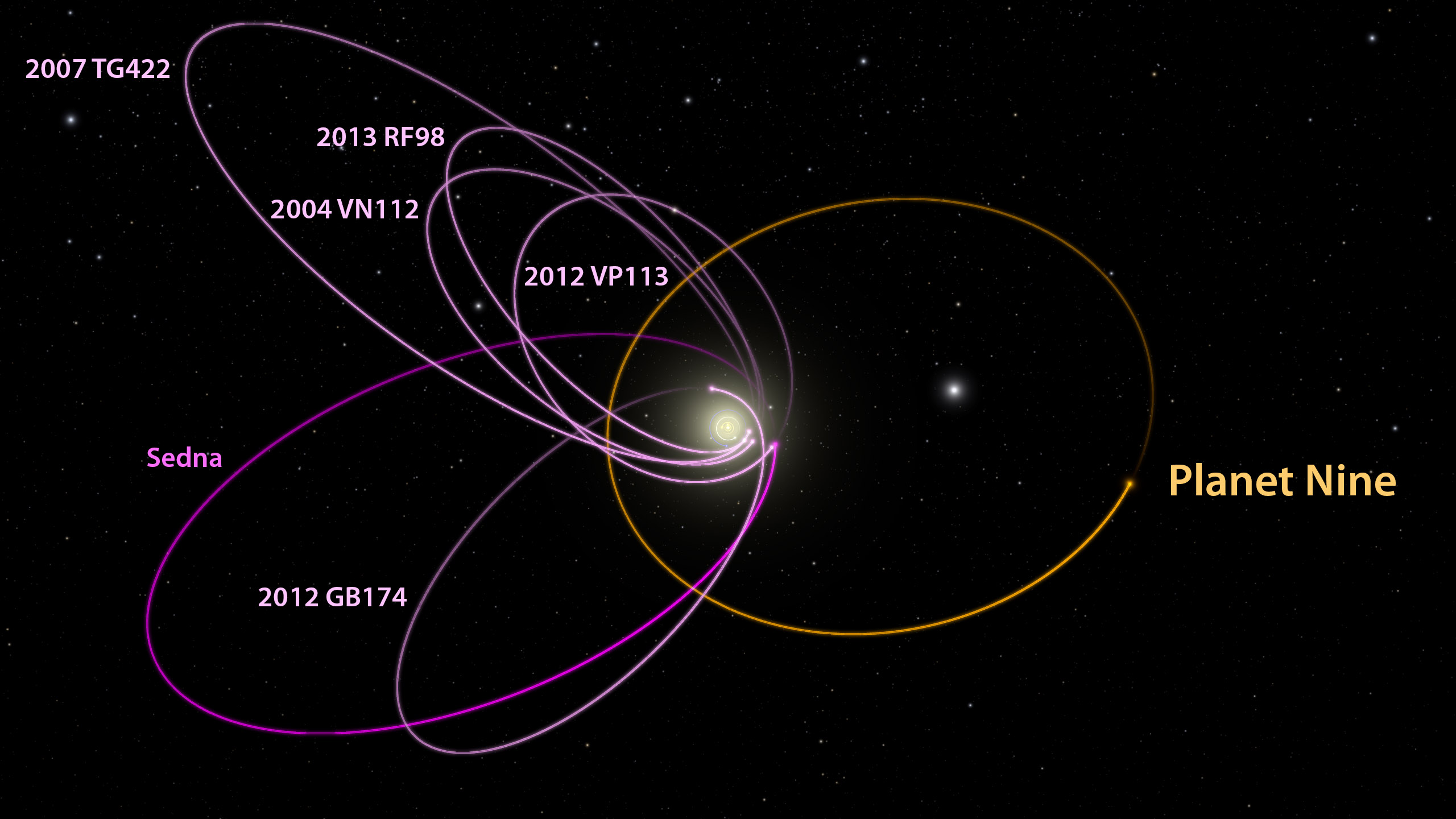
The mystery of Planet Nine — a hypothetical giant planet thought to lurk far beyond Neptune — has taken a new turn as recent discoveries challenge the existing theory. Astronomers have spent years searching for evidence of this hidden world, which is believed to be five to ten times the mass of Earth, orbiting the Sun at a distance of 400 to 800 astronomical units. But every new piece of data seems to deepen the puzzle rather than solve it.
The Planet Nine Hypothesis
The Planet Nine hypothesis was first proposed in 2014 by astronomers Konstantin Batygin and Mike Brown of Caltech. They noticed that several objects in the Kuiper Belt — a region of icy bodies beyond Neptune — had unusual, clustered orbits that seemed to be influenced by a large, unseen planet. The gravitational pull of a Neptune-sized world could explain these anomalies.
Since then, astronomers have searched for Planet Nine using some of the world's most powerful telescopes, including the Subaru Telescope in Hawaii and the Vera C. Rubin Observatory in Chile. Despite extensive search campaigns, no direct observation has been made.
The New Challenge
A recent study published in a leading astronomy journal has cast doubt on the original clustering evidence. The researchers found that observational bias — the tendency to detect certain types of objects more easily than others — could explain the clustered orbits without requiring a hidden planet. When accounting for this bias, the statistical significance of the clustering drops considerably.
| Argument | For Planet Nine | Against Planet Nine |
|---|---|---|
| KBO clustering | Orbits are anomalously clustered | Observational bias explains clusters |
| Gravitational effects | Best explanation for orbital tilts | Other mechanisms possible |
| Direct detection | Not found yet (still searching) | Absence challenges the theory |
| Alternative models | None as compelling | Multiple alternatives proposed |
Why This Matters
The existence — or non-existence — of Planet Nine has profound implications for our understanding of the solar system's formation and evolution. If Planet Nine exists, it would be the fifth-largest planet in our solar system and would reshape our models of planetary formation. If it doesn't, we need new explanations for the peculiar orbits of distant Kuiper Belt objects.
India Angle
Indian astronomers and institutions are actively contributing to the search. The Indian Institute of Astrophysics and the Aryabhatta Research Institute of Observational Sciences are involved in wide-field survey projects that could detect Planet Nine. India's growing space observatory programme, including the planned AstroSat-2 mission, could also contribute to the search for distant solar system objects.
For related Voxlogue context, read New Evidence for Planet Nine Emerges at Edge of Solar System, and Einstein Probe May Have Caught a Black Hole Tearing Apart a White Dwarf for the First Time.
Sources
- ScienceDaily: Planet Nine mystery deepens
- ScienceDaily: Latest Research News
- The Conversation: Planet Nine — new discovery challenges hidden planet theory
- Caltech: Planet Nine hypothesis overview