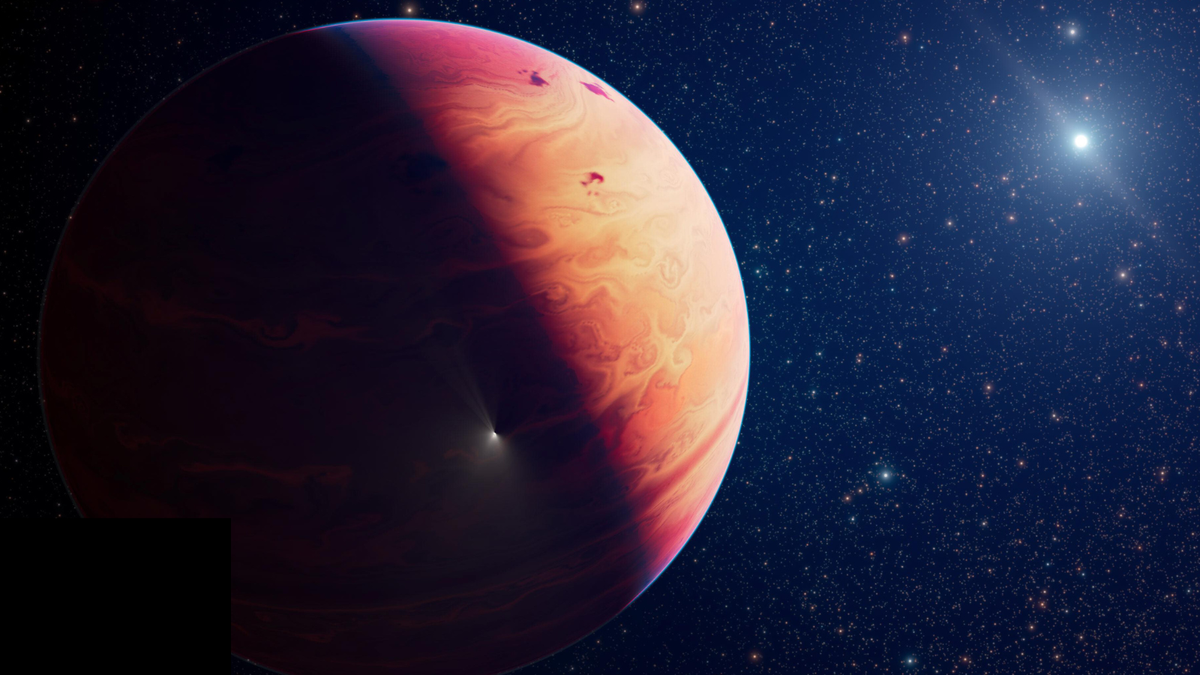
Astronomers using the James Webb Space Telescope have discovered something unprecedented in planetary science: an exoplanet where dawn and dusk have completely different weather. The ultra-hot Jupiter WASP-121 b, located 850 light-years from Earth, exhibits atmospheric behaviour that does not match anything scientists expected — with fierce winds transporting so much heat from the permanent dayside that the evening terminator is actually hotter than the morning one.
What JWST Found
The discovery, published in Nature Astronomy on June 11, 2026, used JWST NIRISS and NIRSpec instruments to measure how starlight absorption changes as WASP-121 b rotates. By probing the planet atmosphere longitude by longitude, researchers found a clear temperature asymmetry: the boundary between day and night behaves differently at dawn than at dusk.
"With its unprecedented observational quality, JWST gives us the most detailed glimpses into distant planets to date," the research team noted. The data revealed massive temperature differences between the dayside and nightside, coinciding with changes in carbon monoxide and water vapour abundance.
Why Dawn and Dusk Are Different
The asymmetry is driven by supersonic winds that transport heat from the scorching dayside — where temperatures exceed 2,500 degrees Celsius — toward the cooler nightside. This heat transport shifts the warmest atmospheric region toward the evening terminator. At dawn, the atmosphere has cooled overnight before rotating back into sunlight; at dusk, it is still radiating heat absorbed during the day.
WASP-121 b is tidally locked to its host star, meaning one side always faces the star (permanent day) and one side always faces away (permanent night). This extreme environment creates atmospheric dynamics unlike anything in our solar system.
Why This Discovery Matters
The finding demonstrates JWST ability to resolve atmospheric features at a level of detail that was impossible with previous telescopes. By mapping exoplanet atmospheres in three dimensions — longitude, latitude, and altitude — astronomers are building the first weather maps of alien worlds. These observations help refine models of atmospheric circulation, cloud formation, and heat transport that are fundamental to understanding planetary climates — including our own.
Sources: Nature Astronomy, Phys.org, Daily Galaxy, ScienceDaily, NASA