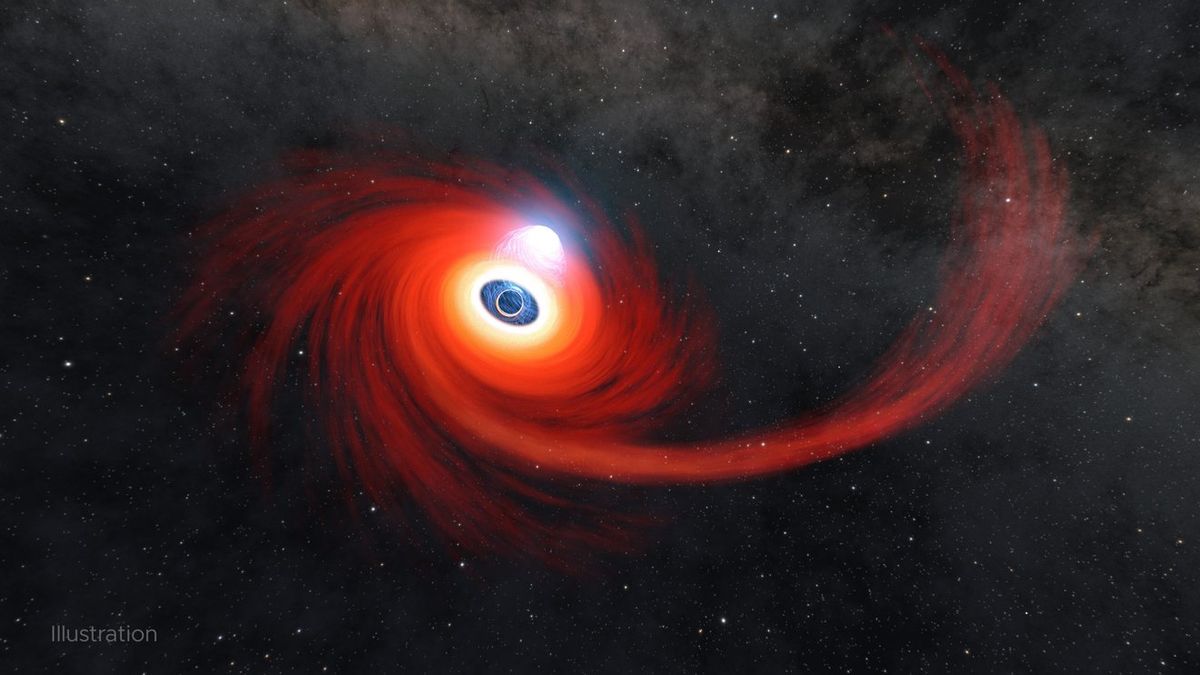
What if some black holes are not black holes at all? A provocative new theoretical study suggests that when a massive star reaches the end of its life and collapses, it might not form a singularity hidden behind an event horizon — it could instead create an entirely new universe.
The Core Idea
Published on June 14, 2026, the study challenges the standard model of stellar death. According to classical astrophysics, stars above a certain mass threshold collapse into black holes — regions of spacetime where gravity is so intense that nothing, not even light, can escape.
But the new theory proposes an alternative: the collapse triggers a quantum bounce, similar to what some cosmologists believe happened during the Big Bang. Instead of crushing matter into an infinitely dense singularity, the collapsing star core could rebound, expanding rapidly into a new spacetime — essentially, a baby universe.
Why This Matters
The theory offers a potential resolution to the long-standing black hole information paradox — the question of what happens to information that falls into a black hole. If black holes are actually gateways to new universes, information is not destroyed; it is simply transferred to a different spacetime.
It also connects to broader cosmological questions, including why our own universe appears so finely tuned for life. If every black hole creates a universe with slightly different physical constants, our cosmos could be just one in a vast multiverse of offspring universes, selected through cosmic natural selection.
Limitations and Future Research
The researchers caution that their work is purely theoretical. Direct observation is by definition impossible — we cannot see beyond an event horizon. However, the theory makes testable predictions about gravitational wave signatures from stellar collapses that could be detected by next-generation observatories like the Laser Interferometer Space Antenna (LISA), scheduled for launch in the mid-2030s.
India Astrophysics Footprint
Indian astrophysicists have been active contributors to this field. India LIGO-India gravitational wave detector, under construction in Maharashtra, will join the global network of observatories when operational in the early 2030s. Indian researchers are also involved in the Square Kilometre Array and Thirty Meter Telescope projects.
Sources: ScienceDaily, Nature, Space.com, EurekAlert, LIGO-India