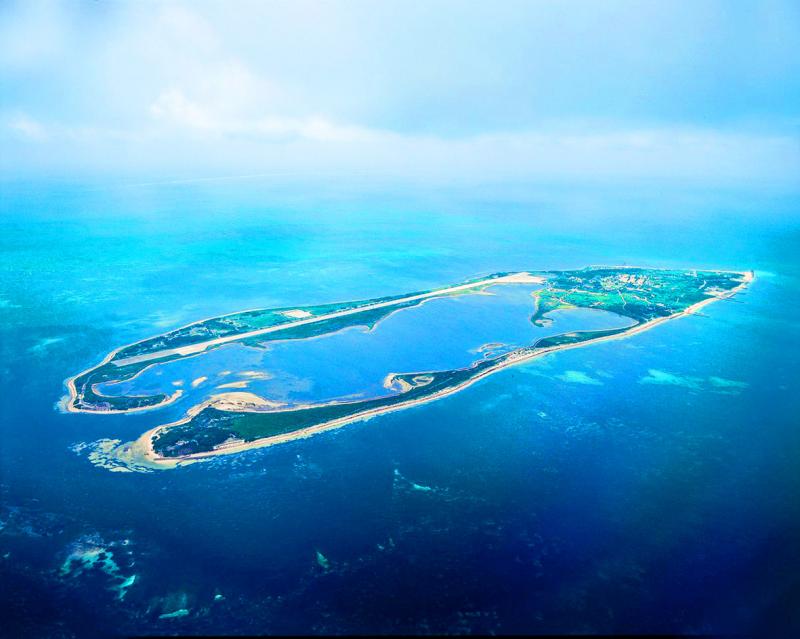
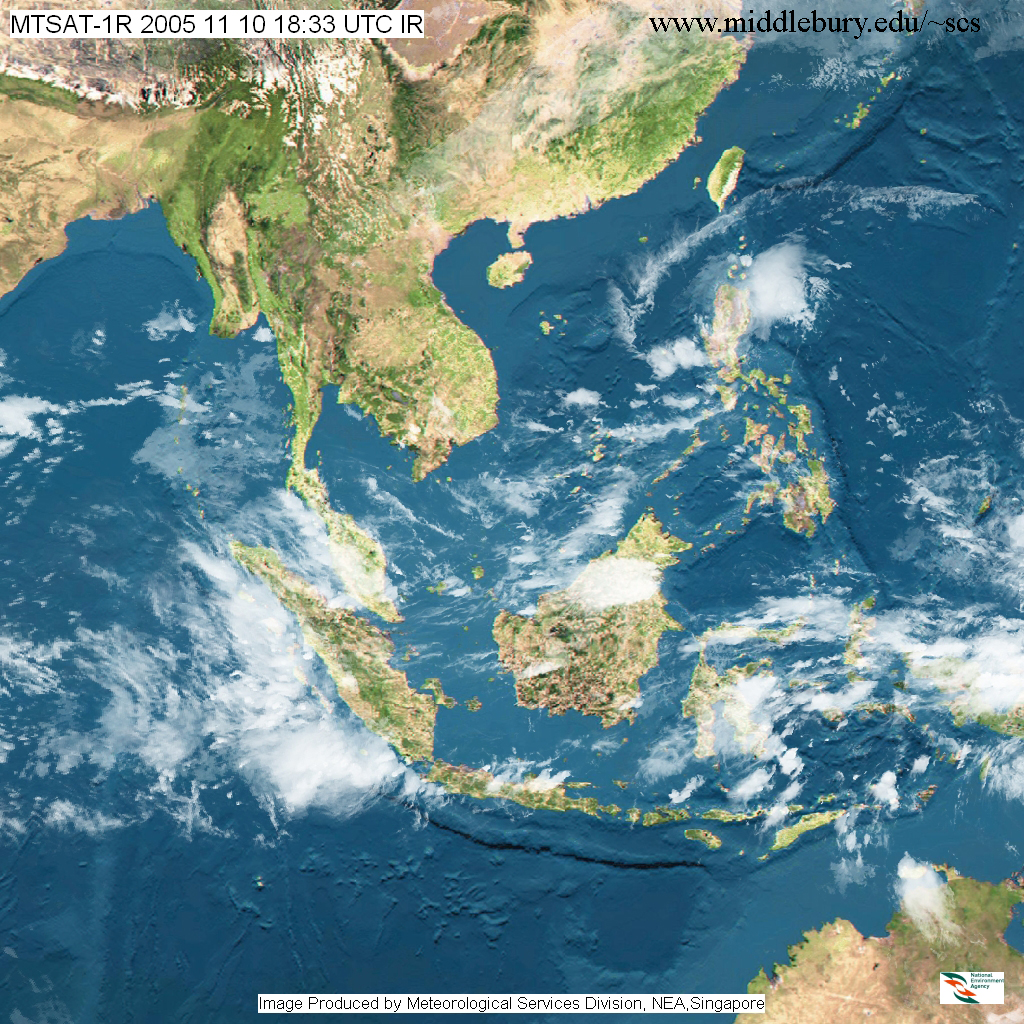
Taiwan and China coast guards were involved in a second standoff at the Pratas Islands in the South China Sea within a fortnight, Reuters reported on June 5, 2026, underscoring a new tempo of maritime pressure in the disputed waterway. The Pratas atoll — also known as the Dongsha Islands — sits at the northern tip of the South China Sea and is administered by Taiwan but claimed by Beijing. The latest incident follows an April 22 New York Times investigation showing Chinese dredgers building a crescent-shaped island on Antelope Reef in the Paracels, and a 2026 pattern of Chinese research and coast-guard vessels approaching the Pratas area.
Timeline: 2026 South China Sea Flashpoints
| 13 April 2026 | Philippine NSC confirms cyanide in bottles allegedly recovered from Chinese boats near Second Thomas Shoal |
| 22 April 2026 | NYT investigation: Chinese dredgers building a new island on Antelope Reef, Paracels |
| 5 June 2026 | Second Taiwan-China coast guard standoff at Pratas in two weeks |
| Day after standoff | Chinese oceanographic research vessel appears near the islands |
| Pattern | Coast guard → research vessel → land reclamation |
Why Pratas Matters
Pratas is a small atoll roughly 300 km southeast of Hong Kong. It is a strategic node: any PLA Navy (PLAN) sortie into the western Pacific can be tracked from the atoll's airstrip, and the lagoon is deep enough to host submarine emergency surfacing. Taiwan's Coast Guard Administration (CGA) maintains a permanent presence there. China's repeated coast-guard and research-vessel approaches are widely read as incremental pressure tests — short of an outright seizure, but normalising a Chinese presence.
The Antelope Reef Pattern
The New York Times visual investigation found satellite evidence that Chinese dredgers are building a crescent-shaped island on Antelope Reef in the Paracels. The Paracels are already under Chinese control, so the new construction is internal consolidation — but the technique is the same one Beijing used to transform reefs in the Spratlys into military-grade artificial islands between 2014 and 2016. That earlier build-out included 3,000-meter runways, radar installations, and surface-to-air missile sites. The Antelope Reef work signals that even the "finished" features of China's South China Sea footprint continue to expand.
What This Means for India
India is one of the few countries in the Indian Ocean region with a stated interest in South China Sea stability. New Delhi's position — codified in the 2019 Ministry of External Affairs statement and reaffirmed in the 2023 joint statement with the ASEAN Outlook on the Indo-Pacific — is that freedom of navigation and overflight must be preserved and that disputes must be settled under UNCLOS. The tri-service Andaman and Nicobar Command (CINCAN), currently headed by Vice Admiral Vineet McCarty (took command June 1, 2026), sits within striking range of the northern entrance to the Malacca Strait — the chokepoint through which the bulk of India's energy imports pass. Any sustained Chinese presence at Pratas adds another link in a chain that could, in a crisis, complicate India's sea lines of communication.
What's at Stake: A Pattern, Not an Incident
The Pratas standoffs are part of a wider 2026 pattern that also includes the Strait of Hormuz crisis and the second Iranian drone attack on US forces in the Persian Gulf this year — both of which echo the same logic of incremental pressure. Beijing is not contesting Pratas the way it contested the Spratlys in 2014-2016. It is normalising presence while the world watches Antelope Reef and the Paracels. Each individual incident is reversible. The pattern is not.
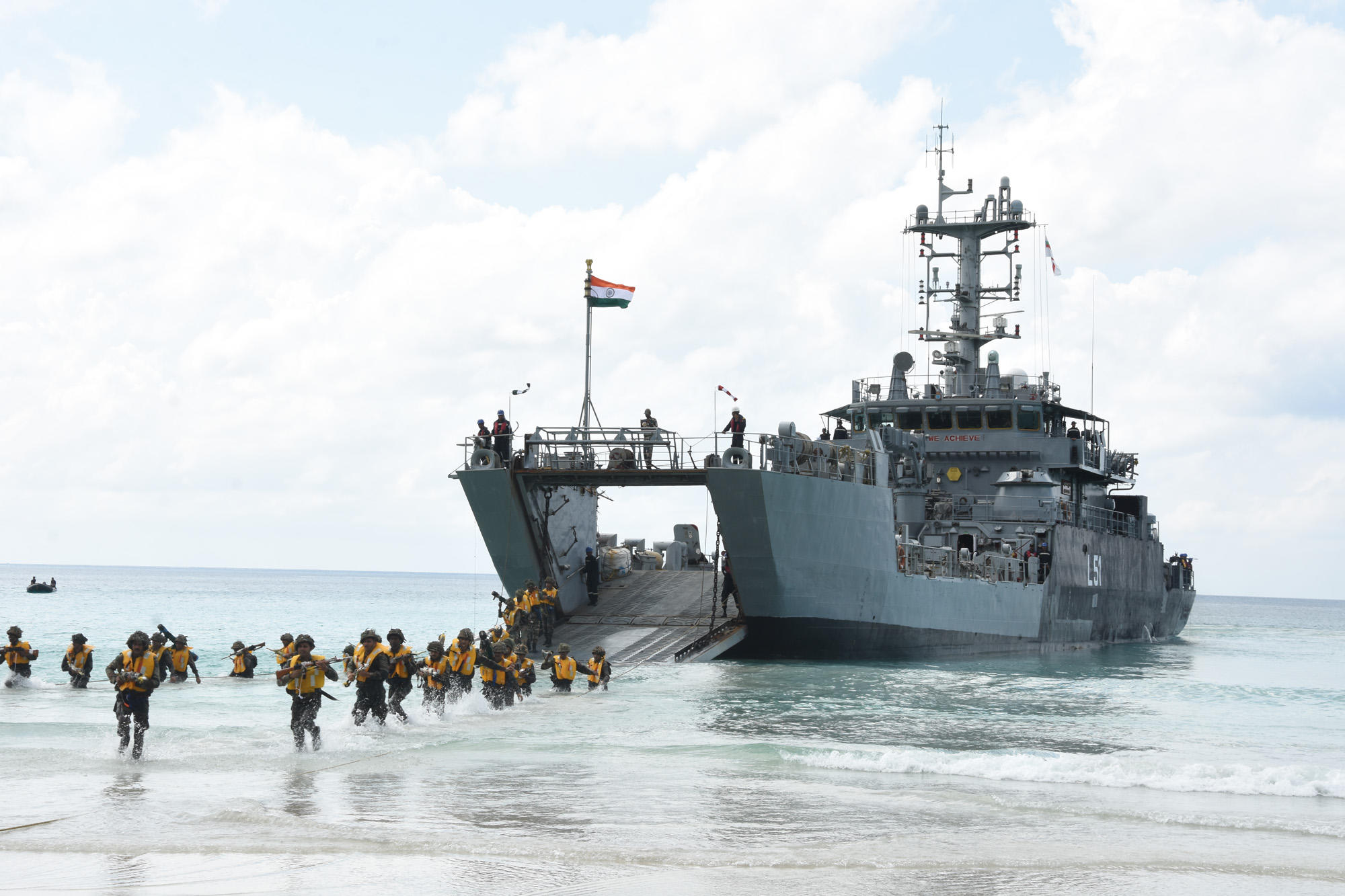
India's posture has shifted in two measurable ways in the last 12 months. First, the Indian Air Force upgraded the runway at Car Nicobar — the southernmost airbase of the Andaman chain — with Su-30 MKI and Mirage 2000 follow-on operations now expected to use the strip (Business Today, December 30, 2025). Second, Indian Navy exercises with Vietnam, the Philippines, Japan, Australia, France and the United States in 2024–2025 have all included South China Sea segments — and India's bilateral logistics agreements with France (2025) and the United States (LEMOA, renewed 2024) give the navy replenishment options in the Western Pacific it did not have a decade ago. India's own SCS claim, articulated in 2011 and reiterated in 2015, is that no country should claim sovereignty over an entire sea lane — and Beijing's nine-dash-line map is therefore incompatible with the parts of UNCLOS India accepts.
For an Indian reader the upshot is this: a Chinese foothold at Pratas would not, on its own, change the military balance. But combined with the Antelope Reef expansion and the steady normalisation of Chinese coast-guard presence in waters India treats as international, it raises the cost of any future Indian Navy operation in the northern South China Sea — including search-and-rescue, HADR, and anti-piracy missions that India has conducted with regional partners.
Sources: Reuters, The New York Times, Wikipedia (Territorial disputes in the South China Sea), Wikipedia (Andaman and Nicobar Command), Business Today (Car Nicobar runway upgrade, Dec 30 2025), UA.NEWS
See also: Haiti's Top Security Official James Boyard Kidnapped in Port · Trump Says Iran Peace Deal Signed Today — Strait of Hormuz t
Sources
- Reuters World — reuters.com/world
- Associated Press — apnews.com
- Voxlogue editorial research